

A telecom network may generate thousands or millions of usage records from calls, messages and data sessions. But those records are not automatically ready to appear on a customer invoice. Different switches and service platforms produce different formats, fields and timestamps. Some records arrive late; others contain gaps or duplicates.
Telecom billing mediation is the process that turns this mixed network data into consistent, validated usage records that downstream systems can rate, bill and analyse. In this guide, we focus on the mediation stage itself—what happens before charges are calculated, and why it matters to operators, VoIP providers and wholesale carriers.
Telecom billing mediation is a data-processing layer between telecom networks and billing or charging systems. It collects usage events, checks their quality, converts them into standard structures, enriches them with relevant identifiers, and sends accepted records to the next system in the workflow.
For example, two VoIP switches might record the same type of call in different layouts. One expresses duration in seconds while another stores milliseconds. A mediation process maps both to the fields and units expected by the billing engine. This helps prevent incorrect charges caused by mismatched input data.
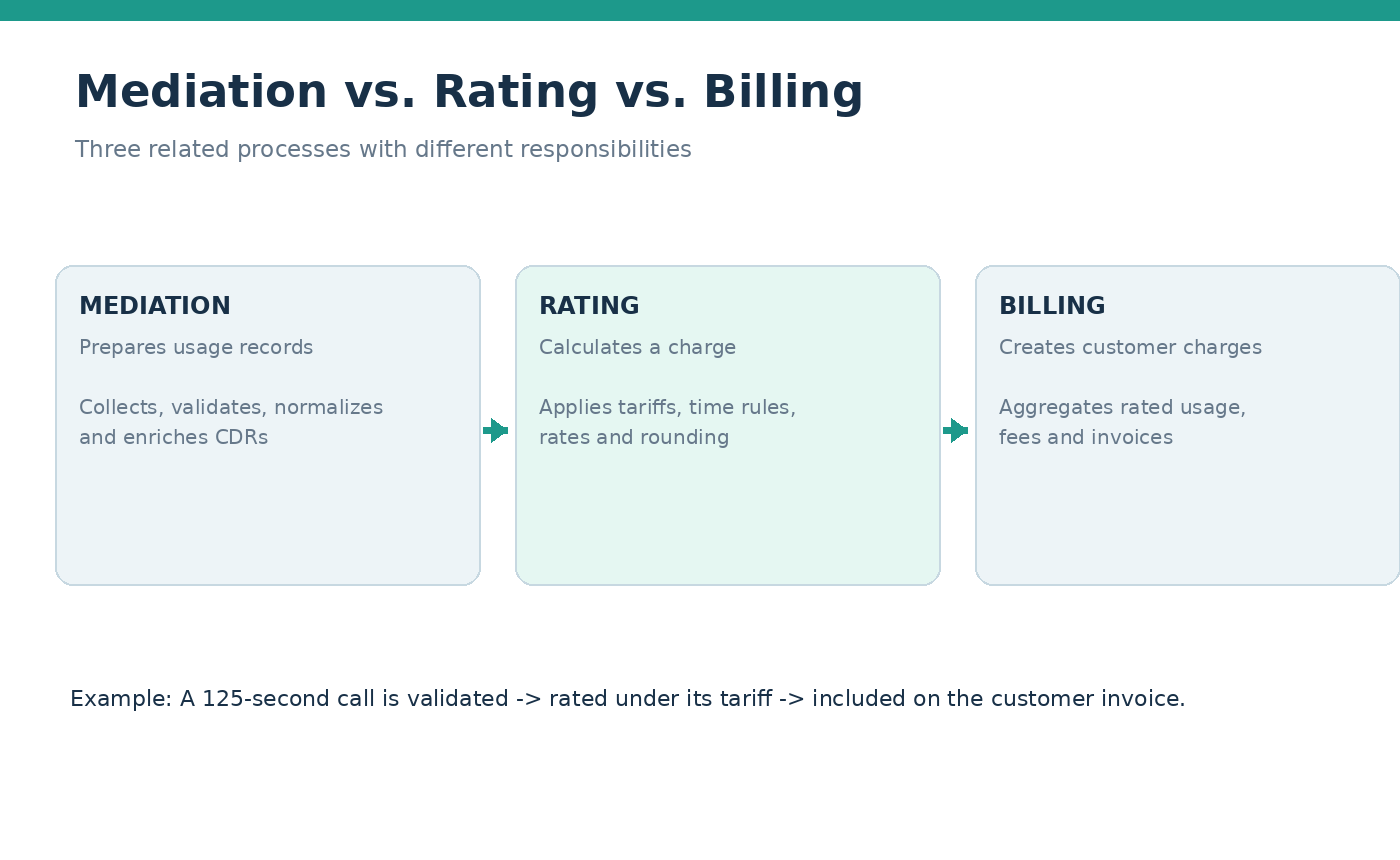
Mediation does not necessarily calculate the final customer charge. That is typically the job of the rating engine. The separation is important: mediation prepares the record; rating applies price rules; billing brings the rated information together in invoices or account balances.
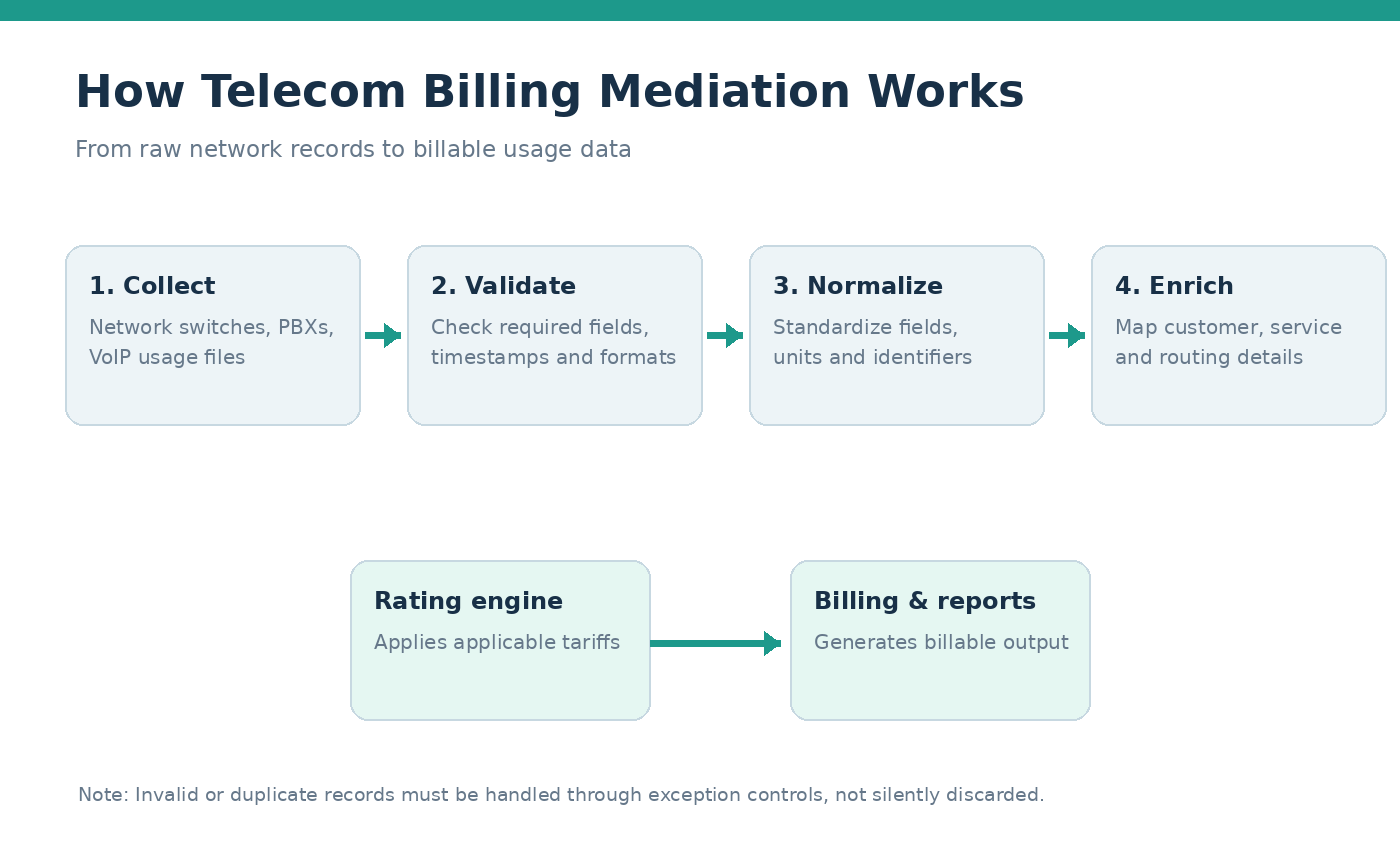
A simplified mediation workflow. Exception handling and reconciliation run alongside these stages.
Network elements such as soft switches, PBXs, mobile systems and VoIP platforms generate event data. A mediation system collects it through supported feeds, files, APIs or other adapters. It may ingest call detail records (CDRs), session records and other service usage events, depending on the provider.
The system checks whether each record has the required fields and whether values follow expected rules. Typical checks include timestamp format, call identifiers, origin and destination values, duration, and source integrity. Incomplete records should be flagged for investigation or controlled reprocessing rather than silently ignored.
Normalization maps source-specific field names, codes, time zones and units into a common format. For instance, start time and call Start might become a single standard field. Normalization also ensures that the downstream rating engine receives predictable data from multiple providers.
Retransmissions or overlapping feeds can result in duplicate events. Systems can use reliable identifiers, source metadata and carefully designed rules to detect duplicates. When a single call spans multiple record fragments, correlation or aggregation rules may be needed. These controls must be designed carefully: two genuinely different calls should never be mistaken for one.
Enrichment attaches context that the raw network record may not contain: an account identifier, a service category, a partner, a product, a direction of traffic, or the relevant plan reference. This makes usage data meaningful to rating, settlement and reporting systems.
Once processed, accepted usage records are delivered to downstream systems in the required format. Failed records are logged, monitored and retried or reviewed through exception workflows. Operators should also compare record counts and volumes across stages to detect unexplained losses.
| Field | Raw source record | After mediation |
|---|---|---|
| Customer identifier | blank | Account ID: AC-1042 (mapped) |
| Call duration | 125000 milliseconds | 125 seconds |
| Event time | 2026-10-01 14:20 UTC | 2026-10-01T14:20:00Z |
| Destination | 0044207XXXXXXX | +44207XXXXXXX |
| Record status | Unvalidated | Validated and ready for rating |
Graphic 2. Mediation, rating and billing are connected, but they perform separate tasks.
| Process | Main question answered | Typical output |
|---|---|---|
| Mediation | Is this usage record complete and usable? | Standardized usage data |
| Rating | How much should this usage cost? | Rated event / calculated charge |
| Billing | What should appear on the customer bill? | Invoice or account balance |
Batch mediation processes collected events at scheduled intervals, such as hourly or overnight. It is useful when source data is delivered as files and when immediate balances are not required. Near-real-time mediation processes records as they arrive or with short delays, supporting faster visibility into usage and anomalies. Neither approach is universally better; the right design depends on upstream data availability, billing needs, latency tolerance and cost.
Missing records: network or transfer failures can leave a gap between actual usage and received usage.
Duplicate CDRs: retries and overlapping feeds can create a double-charging risk if not controlled.
Different source formats: each switch or partner may use different field names, encodings and units.
Late-arriving events: records received after a billing cutoff may require special handling.
Incorrect account mapping: usage linked to the wrong customer or partner can cause disputes.
Insufficient reconciliation: without source-to-output counts and exception reports, losses may remain unnoticed.
Reliable mediation improves the quality and traceability of the data that drives billing. By detecting anomalies before rating, it can reduce avoidable corrections and support more consistent invoice preparation. For wholesale providers, it also helps ensure partner traffic is mapped and compared correctly. For operations teams, standardized data and exception logs make investigations faster and more repeatable.
These benefits depend on sound configuration, input quality, reconciliation and operational monitoring. Mediation alone cannot guarantee zero billing errors or eliminate revenue leakage.
Support for the actual CDR or usage formats produced by your network and carrier partners.
Configurable validation and mapping rules with clear version control.
Duplicate detection and documented exception handling.
Reconciliation reports comparing source, accepted, rejected and delivered volumes.
Reliable retry, replay and audit capabilities.
Usable integration with rating, invoicing and reporting systems.
Appropriate security, retention and access controls for sensitive usage data.
Neon Soft describes automated CDR collection, billing, rate management, reporting and integrations for telecom providers. Those capabilities are relevant to the broader usage-to-invoice workflow. For product-specific details, including supported mediation formats, transformation rules and exception handling, operators should request a demonstration and verify the exact functionality with the Neon Soft team.
To explore related topics, see Neon Soft’s existing guides on CDR billing, telecom billing processes, and revenue assurance. Suggested internal links are supplied at the end of this document.
Ans: It is the process of collecting, checking, transforming and enriching telecom usage records so downstream rating and billing systems can use them.
Ans: No. Mediation prepares usage data; rating calculates the charge using the appropriate price rules.
Ans: It can detect and flag duplicate records before rating, if deduplication rules and exception controls are correctly configured.
Ans: Yes. The underlying concept applies to multiple telecom services, though event formats and required processing differ.
Ans: Well-designed systems log them as exceptions and support investigation, correction and controlled reprocessing.
Ans: No. Batch or near-real-time processing can both be valid, depending on the operator’s use case and the availability of source records.
Telecom billing mediation turns raw usage events into reliable inputs for charging, invoicing and reporting. Its most important work happens before a customer sees an invoice: collecting records, validating them, standardizing formats, mapping identifiers and handling exceptions. Understanding this layer makes it easier to diagnose billing disputes, reconcile partner traffic and improve the quality of telecom billing operations.
Want to see how your current network data can flow into an automated telecom billing environment? Explore Neon Soft’s billing capabilities or request a product demonstration.
Looking to improve CDR processing, standardize usage records, and streamline your telecom billing workflow?
Explore Neon Soft’s telecom billing capabilities and discover how automated CDR collection, rate management, reporting, and integrations can support your operations.
Talk to Our Team